Asian Art
Kangxi Tongbao
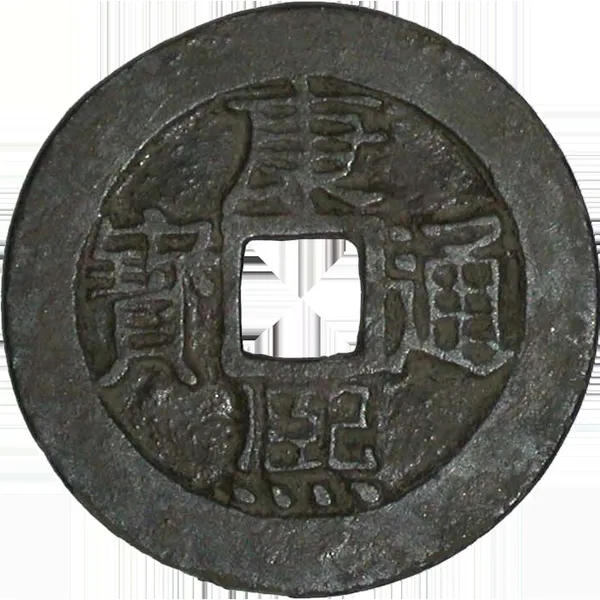
Kangxi Tongbao (traditional Chinese: 康熙通寶; simplified Chinese: 康熙通宝; pinyin: kāng xī tōng bǎo) refers to an inscription used on Chinese cash coins produced during the reign of the Kangxi Emperor of the Manchu-led Qing dynasty. Under the Kangxi Emperor the weights and standards of the brass cash coins changed several times and the bimetallic system of Qing dynasty coinage was established. Today Kangxi Tongbao cash coins are commonly used as charms and amulets where different forms of superstition have developed arounds its mint marks and calligraphy. A notable characteristic is that the outer rim on Kangxi Tongbao cash coins on both sides of the coin tend to be quite wide, in contrast to that of the square center hole (方穿, fāng chuān). Apart from the two mints in the capital city of Beijing operated by the central government, many provincial mints operated intermittently.
Also on this shelf
Cult image.
Hojōjutsu.
See also
Uncatalogued shelfText from Wikipedia; plate via Wikimedia Commons. Text CC BY-SA 4.0; plate freely licensed (see Commons). Source record. Images and catalogue data are reproduced from open-access collections.