Astronomy and Space
Kepler-452b
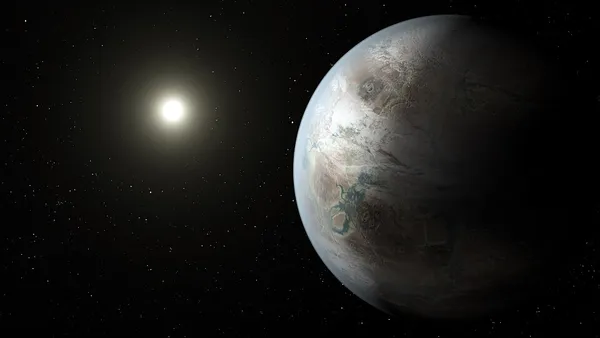
Kepler-452b (sometimes quoted to be an Earth 2.0 or Earth's Cousin based on its characteristics; also known by its Kepler object of interest designation KOI-7016.01) is a disputed super-Earth exoplanet candidate. Initial reports claim it is orbiting within the inner edge of the habitable zone of the sun-like star Kepler-452 and is the only planet in the system discovered by the Kepler space telescope. It is located about 1,800 light-years (550 pc) from Earth in the constellation of Cygnus. Two subsequent reports refuted the claim but additional work has reestablished the claim. Kepler-452b orbits its star at a distance of 1.04 AU (156 million km; 97 million mi) from its host star (nearly the same distance as Earth from the Sun), with an orbital period of roughly 385 days, has a mass at least three times that of Earth, and has a radius of around 1.63 times that of Earth, or around 63% larger than earth in size. It is the first potentially rocky super-Earth planet discovered orbiting within the habitable zone of a very Sun-like star. However, it is unknown if it is entirely habitable, as it is receiving slightly more energy from its star than Earth and could be subjected to a runaway greenhouse effect. The Kepler space telescope identified the exoplanet, and its discovery was announced by NASA on 23 July 2015. The planet is about 1,800 light-years (550 pc) away from the Solar System. At the speed of the New Horizons spacecraft, at about 59,000 km/h (16,000 m/s; 37,000 mph), it would take approximately 30 million years to get there.
Also on this shelf
Kennedy Space Center Visitor Complex.
Defence industry of India.
See also
Uncatalogued shelfText from Wikipedia; plate via Wikimedia Commons. Text CC BY-SA 4.0; plate freely licensed (see Commons). Source record. Images and catalogue data are reproduced from open-access collections.