Musical Instruments
Contrabass clarinet
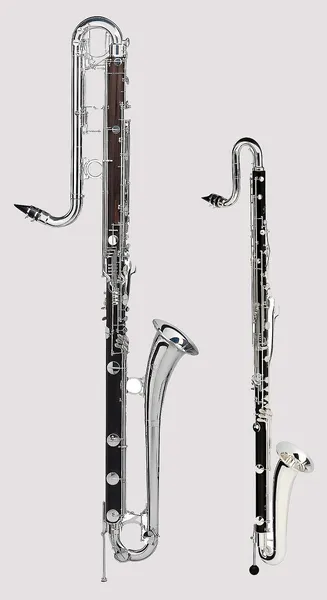
The contrabass clarinet (or pedal clarinet after the pedals of pipe organs) is an uncommonly used member of the clarinet family. Modern contrabass clarinets are transposing instruments pitched in B♭, sounding two octaves lower than the common B♭ soprano clarinet and one octave below the bass clarinet. Some contrabass clarinet models have extra keys to extend the range down to low written E♭3, D3 or C3. This gives a tessitura written range, notated in treble clef, of C3 – F6, which sounds B♭0 – E♭4. Some early instruments were pitched in C; Arnold Schoenberg's Fünf Orchesterstücke specifies a contrabass clarinet in A, but there is no evidence such an instrument has ever existed. The smaller E♭ contra-alto clarinet is sometimes referred to as the "E♭ contrabass clarinet" and is pitched one octave lower than the E♭ alto clarinet. Two models of subcontrabass clarinet (the octocontra-alto and octocontrabass) were built as prototypes by Leblanc in the 1930s and survive in the Leblanc museum.
Also on this shelf
Ashiko.
John Reid (British Army officer).
See also
Uncatalogued shelfText from Wikipedia; plate via Wikimedia Commons. Text CC BY-SA 4.0; plate freely licensed (see Commons). Source record. Images and catalogue data are reproduced from open-access collections.