Writing and Printing
Ancient South Arabian script
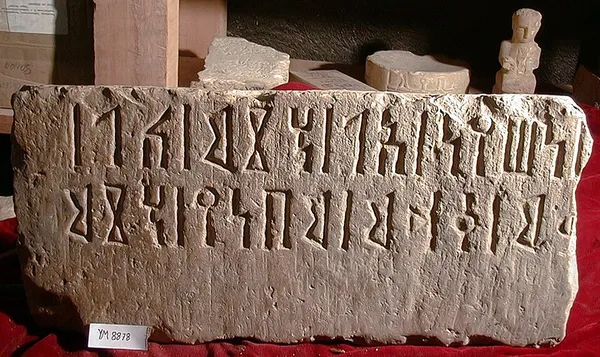
The Ancient South Arabian script (Old South Arabian: 𐩣𐩯𐩬𐩵, romanized: ms3nd; modern Arabic: الْمُسْنَد musnad) branched from the Proto-Sinaitic script in about the late 2nd millennium BCE, and remained in use through the late sixth century CE. It is an abjad, a writing system where only consonants are obligatorily written, a trait shared with its predecessor, Proto-Sinaitic, as well as some of its sibling writing systems, including Arabic and Hebrew. It is a predecessor of the Ge'ez script, and a sibling script of the Phoenician alphabet and, through that, the modern Latin, Cyrillic, and Greek alphabets. The script is really two variants: the monumental and the minuscule script, the former for inscriptions, the latter scratched with wooden sticks. The scripts have a common origin but evolved into separate systems.
Also on this shelf
History of agriculture in the Indian subcontinent.
Georgian graffiti of Nazareth and Sinai.
See also
Uncatalogued shelfText from Wikipedia; plate via Wikimedia Commons. Text CC BY-SA 4.0; plate freely licensed (see Commons). Source record. Images and catalogue data are reproduced from open-access collections.